How to keep score in golf: a hole-by-hole guide for beginners
To keep score in golf, count every stroke you make on a hole, add any penalty strokes, and write that total on the scorecard. Your score for the round is the sum of all holes. Compare each hole to its par to see where you stand: one under par is a birdie, one over is a bogey.
| Golf score terms | Strokes vs par | Example on a par 4 |
|---|---|---|
| Albatross (double eagle) | 3 under | 1 |
| Eagle | 2 under | 2 |
| Birdie | 1 under | 3 |
| Par | Even | 4 |
| Bogey | 1 over | 5 |
| Double bogey | 2 over | 6 |
| Triple bogey | 3 over | 7 |
How do you keep score in golf?
Count every stroke from the tee until the ball is in the hole, add any penalty strokes, and write that number down for the hole. Do the same on every hole, then add them up for your round score. Comparing each hole to its par tells you whether you’re over or under par as you go.
The basic version of golf, stroke play, is simply the lowest total wins. The Rules of Golf (Rule 3.3) describe your score for a hole as the strokes you made plus any penalty strokes. Everything else on a scorecard is detail around that one number.
What counts as a stroke?
A stroke is any forward swing you make to hit the ball, whether you hit it well, top it, or miss it completely. Tee shots, chips, bunker shots, and putts all count. Practice swings don’t, because you weren’t trying to hit the ball. That’s the definition of “stroke” in the Rules.
A few cases golfers often ask about:
- A whiff. You swung to hit the ball and missed. It counts as a stroke.
- A tap-in. Even a two-inch putt is a stroke and goes on the card.
- A practice swing that bumps the ball. Not a stroke, because you weren’t trying to hit it. But moving your ball in play usually costs one penalty stroke, and you put it back (Rule 9.4). On the tee before your first shot there’s no penalty: just re-tee.
How do penalty strokes work?
Penalty strokes are added to your score when a rule costs you, most often for a lost ball, a ball out of bounds, or taking relief from water. Each of these common situations costs one penalty stroke. Penalty strokes count exactly like swings: add them to that hole’s total.
| Situation | Penalty | What you do next | Rule |
|---|---|---|---|
| Ball lost (not found within 3 minutes) | 1 stroke | Play again from where you hit the previous shot | Rule 18 |
| Ball out of bounds | 1 stroke | Play again from where you hit the previous shot | Rule 18 |
| Ball in a penalty area (water, red or yellow stakes) | 1 stroke | Take relief using one of the options in the rule | Rule 17 |
| Ball unplayable (you choose not to play it) | 1 stroke | Take relief using one of the options in the rule | Rule 19 |
Lost ball and out of bounds are often called stroke and distance: you add a penalty stroke and lose the distance of the shot, because you replay it. That’s why a tee shot out of bounds means you’re hitting your third shot from the tee.
How do you fill in a golf scorecard?
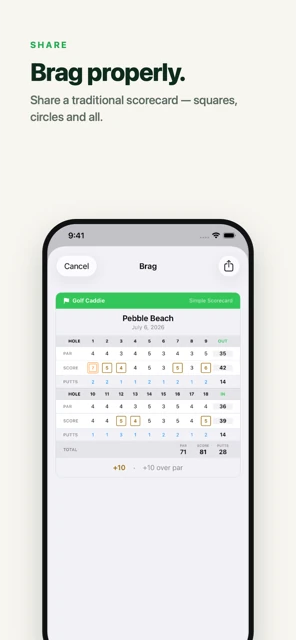
Write one number per hole: your strokes plus penalties. Many golfers also note putts and penalties in small boxes, so the card shows where strokes went. Total the front nine, the back nine, and the round. Compare the total to the course par to get your score over or under par.
Here’s a worked example on three holes:
| Hole | Par | What happened | Strokes | Putts | Penalties | Hole score | vs par |
|---|---|---|---|---|---|---|---|
| 1 | 4 | Drive, approach just off the green, chip, 2 putts | 3 | 2 | 0 | 5 | Bogey (+1) |
| 2 | 3 | Tee shot onto the green, 2 putts | 1 | 2 | 0 | 3 | Par (E) |
| 3 | 5 | Drive out of bounds, re-tee, 2 more shots to the green, 1 putt | 4 | 1 | 1 | 6 | Bogey (+1) |
| 12 | 14 | +2 |
On hole 3, the drive out of bounds is still a stroke, the re-teed drive is another, and the penalty adds one more. In the “Strokes” column, every shot before the green counts; putts and penalties are counted separately so the card shows where strokes went.
What do birdie, par, and bogey mean?
Par is the number of strokes a skilled player is expected to need on a hole, usually 3, 4, or 5. Each stroke under par has a name: birdie is one under, eagle two under. Strokes over par are bogeys: one over is a bogey, two over a double bogey. The table at the top lists them all.
A hole in one is an ace, whatever the par. On a par 3 it’s also an eagle; on a par 4 it’s an albatross.
How do you track your score against par during a round?
Keep a running total of strokes over or under par after each hole, instead of adding the raw numbers. After a bogey, a par, and a bogey, you’re “plus two” (+2). It’s easier to follow than a growing total, and it’s how scores are shown on TV and on most scoreboards.
In the example above, the round so far is 14 strokes on holes with a total par of 12, so you’re at +2. A birdie on the next hole would bring you back to +1.
Can you keep score in an app instead of on paper?
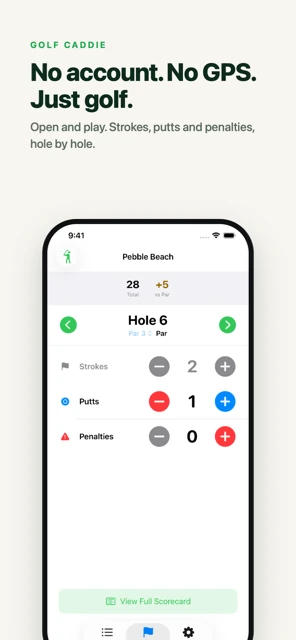
Yes. A scorecard app does the adding for you and shows your score against par after every hole. In Golf Caddie, you tap + for strokes, putts, and penalties on each hole; the app totals them the same way as the worked example above: strokes plus putts plus penalties. It’s free on iPhone with unlimited rounds.
When you finish, you can share a classic scorecard image, with circles for birdies and squares for bogeys. With Pro you can also score from your Apple Watch, by voice with Siri, or from the iPhone Lock Screen. See how Golf Caddie works or keeping score on an Apple Watch without GPS.
Frequently asked questions
Do practice swings count as strokes?
No. A stroke is a forward swing made to hit the ball. Practice swings aren’t made to hit the ball, so they don’t count as strokes, even if you accidentally knock the ball with one (though moving your ball in play usually costs a penalty stroke). A swing that’s meant to hit the ball and misses completely does count.
What's the maximum score on a hole?
In regular stroke play there’s no maximum: you count every stroke until the ball is in the hole. Many casual groups agree on a limit, such as double par, to keep play moving. Scores you post for a handicap have their own per-hole limit under the World Handicap System (net double bogey).
Who keeps score in a competition?
In stroke play competitions, a marker (usually another player in your group) records your score for each hole. You and the marker both certify the scorecard after the round, and you hand it in. See Rule 3.3 of the Rules of Golf.
Do putts count as strokes?
Yes. Every putt is a stroke and counts toward your score. Many golfers also record putts separately, so they can see how many strokes they take on the green. See how to track putts.